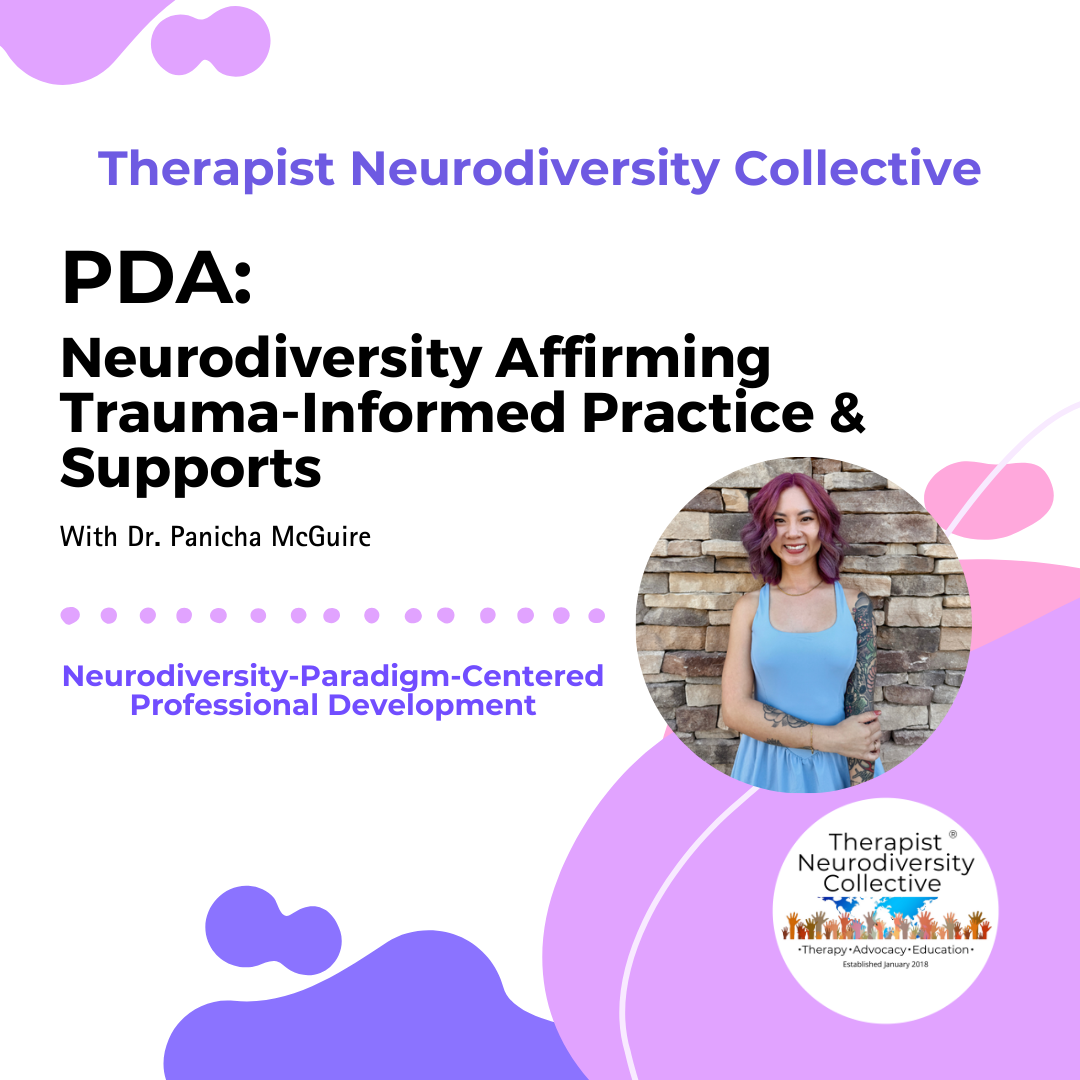
Description
This course focuses on PDA trauma-informed practice grounded in neurodiversity-affirming principles.
This in-depth professional training on Pathological Demand Avoidance (PDA) is designed for therapists, educators, and related professionals seeking neurodiversity-affirming, trauma-informed approaches to supporting Autistic and neurodivergent individuals with a PDA profile.
Hosted by Therapist Neurodiversity Collective and presented by Dr. Panicha McGuire, this course provides a research-aligned, practical framework for PDA trauma-informed practice. PDA is explored as an anxiety-driven need for autonomy rather than a behavior problem or oppositional pattern. Participants will learn how demands interact with the nervous system, why compliance-based approaches often escalate distress, and how trauma informed PDA care centers safety, collaboration, and autonomy across home, school, and community settings.
Pathological Demand Avoidance, also described as Persistent or Pervasive Drive for Autonomy, is widely recognized within neurodiversity-affirming practice and lived-experience communities, despite not being formally classified as a standalone diagnosis. This course offers a comprehensive overview of PDA across the lifespan and examines its connections to anxiety, threat response, and nervous system dysregulation. Emphasis is placed on felt safety, co-regulation, and relational trust, with concrete strategies that reduce demand-related anxiety while strengthening autonomy and connection.
This training supports professionals seeking to move away from compliance-based models and toward trauma informed PDA care that respects neurodivergent nervous systems and lived experience.
This course is appropriate for speech-language pathologists, occupational therapists, mental health professionals, educators, psychologists, social workers, and others supporting neurodivergent children, teens, and adults.
What You Will Learn
Deepen Understanding of PDA
Expand professionals’ and families’ understanding of PDA’s defining characteristics and how it presents across different ages. This understanding supports greater empathy and more accurate identification of a PDA profile.
Integrate Trauma-Informed Perspectives
Shift away from compliance-based approaches by understanding demand avoidance as a response to anxiety or nervous system distress rather than willful defiance. Participants will strengthen their ability to create environments that support felt safety, co-regulation, and trust for PDA individuals.
Enhance Support Strategies
Gain neurodiversity-affirming strategies and practical tools that support autonomy and reduce demand-related anxiety across home, school, and community settings. Participants will be prepared to implement flexible supports and accommodations that improve daily functioning and relationships for individuals with PDA.
► Featuring: Dr. Panicha McGuire
► Enrollees have on-demand access to this course for 180 days from enrollment.
► 2 hours of Professional Development credit
► Audience: Mental health professionals, psychologists, speech-language pathologists, occupational therapists, educators, social workers, and others supporting neurodivergent children, teens, and adults. 🔓🔓🔓 (Therapy Neurodiversity Collective Members, this short course is included in your membership!)
✨ Included:
☑ Handouts
☑ Certificate of Attendance for 2 hours of professional development

Dr. Panicha McGuire, LMFT, RPT™, PsyD, is an AuDHDer and a dedicated advocate for neurodivergent-affirming, decolonial, and liberation-focused mental health practices. With over a decade of experience working with neurodivergent children, teens, and adults, Dr. Panicha’s approach is deeply rooted in intersectionality, honoring the lived experiences of the global majority, the 2SLGBTQIA+ community, and others marginalized by dominant systems. Dr. Panicha challenges the Eurocentric, medicalized models of psychology and psychiatry that have historically pathologized difference and reinforced systemic oppression. She believes in shifting from compliance-based approaches toward frameworks that foster self-determination, authenticity, and collective healing. She actively engages in communal learning, recognizing that knowledge is not just held by professionals, but also by lived experience and community wisdom. Dr. Panicha not only supports her clients in reclaiming their neurodivergent and cultural identities, but also equips fellow professionals with the tools to depathologize, decolonize, and integrate neurodiversity-affirming principles into their own practices. She believes that true healing is not about forcing individuals to conform, but about building communities where neurodivergent and marginalized individuals are valued, accommodated, and free to thrive.
www.livinglotustherapy.com
Socials: IG/Tiktok- @drpanichamcguire


