Description
You understand PDA. Now learn how to write goals, plan supports, & answer the real-world “what about…” questions that come next.
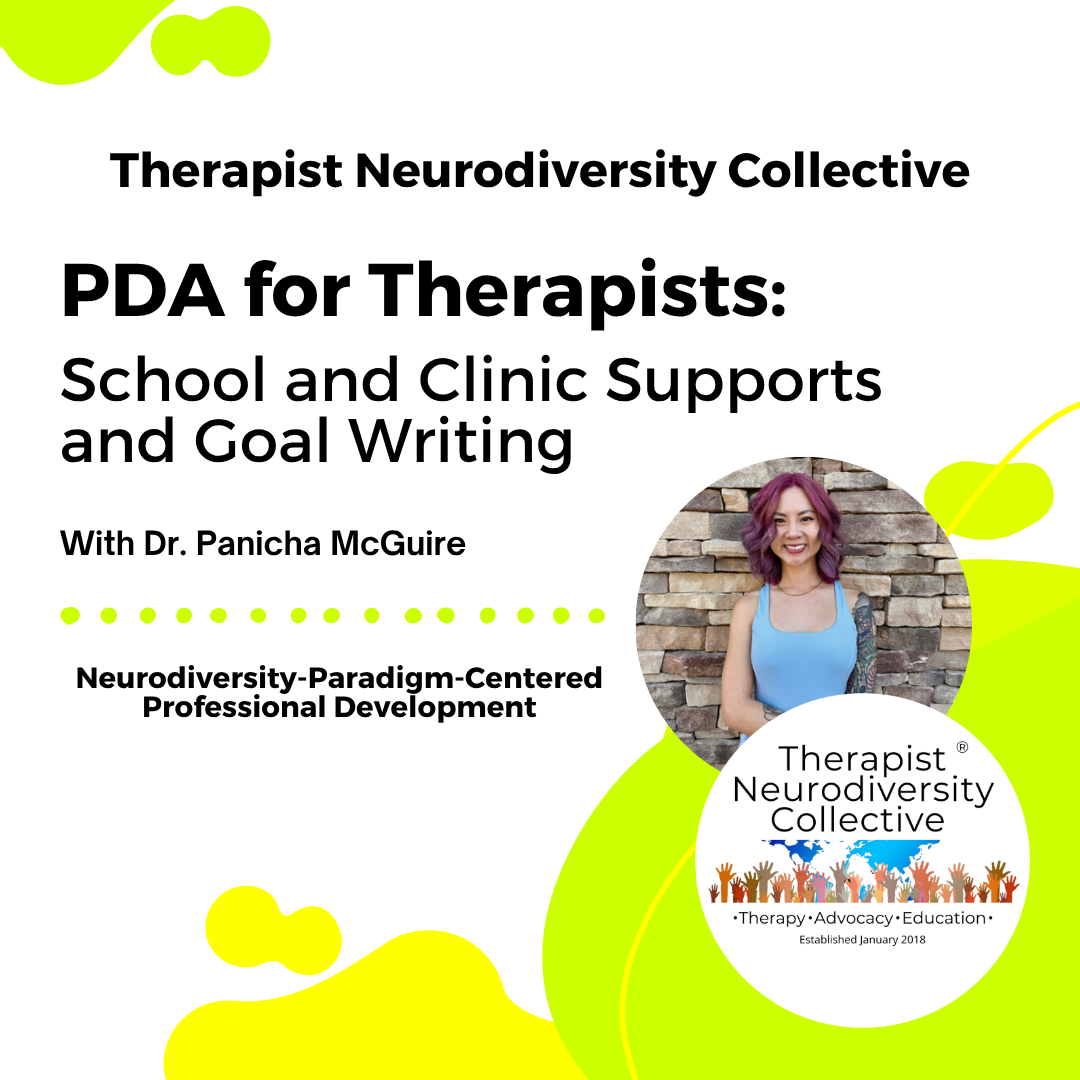
Following the popularity of Dr. Panicha McGuire’s first course, PDA: Neurodiversity-Affirming, Trauma-Informed Practice & Supports, this applied part-two training helps therapists and educators move from understanding Persistent or Pervasive Drive for Autonomy, historically referred to as Pathological Demand Avoidance, to implementing practical, neurodiversity-affirming supports in school and clinical settings.
This two-hour professional development course focuses on the “what about…” questions that often arise when supporting PDA-ers:
What about IEPs and 504 plans? What about goal writing? What about visual schedules that increase distress? What about teams that want consequence plans? What about students who engage with one adult but not another?
Dr. McGuire will guide participants through PDA-informed approaches to school and clinic supports, with specific attention to demand sensitivity, autonomy, relational safety, accommodation planning, and goal writing. Participants will learn how to conceptualize PDA within compliance-driven systems while advocating for supports that reduce threat, preserve dignity, and improve access to learning and participation.
The course includes practical guidance on developing autonomy-supportive goals with clear baselines, conditions, criteria, timelines, and measurement methods. Participants will also examine accommodations across communication, transitions, sensory needs, environment, scheduling, de-escalation, and team collaboration.
Participants will leave with a clearer understanding of how to write PDA-informed goals, advocate within school and clinical systems, and collaborate with teams to create supports that are low-arousal, flexible, autonomy-supportive, and sustainable.
This course is appropriate for school counselors, speech-language pathologists, occupational therapists, mental health professionals, educators, psychologists, social workers, and others supporting neurodivergent children, teens, and adults.
Participants will learn to:
- Apply a PDA focused, trauma-informed, neurodiversity-affirming framework to understand demand sensitivity in school and clinical systems.
- Identify when 504 plans, IEPs, accommodations, or additional supports may be appropriate.
- Develop PDA-informed accommodations and goals that prioritize autonomy, safety, relational engagement, and access to learning.
- Write measurable goals using baselines, conditions, observable actions, criteria, timelines, and appropriate data collection methods.
- Troubleshoot common PDA support challenges, including visual supports, escalation, stalled goals, transition demands, and team requests for consequence-based plans.
► Featuring: Dr. Panicha McGuire
► 2 hours of Professional Development credit.
► Enrollees have 180 days to access the course on-demand, any time, anywhere.
► Audience: School counselors, mental health professionals, psychologists, speech-language pathologists, occupational therapists, educators, social workers, and others supporting neurodivergent children, teens, and adults. 🔓🔓🔓 (Therapy Neurodiversity Collective Members, this short course is included in your membership!)
✨ Included:
☑ Handouts
☑ Certificate of Attendance for 2 hours of professional development

Dr. Panicha McGuire, LMFT, RPT™, PsyD, is an AuDHDer and a dedicated advocate for neurodivergent-affirming, decolonial, and liberation-focused mental health practices. With over a decade of experience working with neurodivergent children, teens, and adults, Dr. Panicha’s approach is deeply rooted in intersectionality, honoring the lived experiences of the global majority, the 2SLGBTQIA+ community, and others marginalized by dominant systems. Dr. Panicha challenges the Eurocentric, medicalized models of psychology and psychiatry that have historically pathologized difference and reinforced systemic oppression. She believes in shifting from compliance-based approaches toward frameworks that foster self-determination, authenticity, and collective healing. She actively engages in communal learning, recognizing that knowledge is not just held by professionals, but also by lived experience and community wisdom. Dr. Panicha not only supports her clients in reclaiming their neurodivergent and cultural identities, but also equips fellow professionals with the tools to depathologize, decolonize, and integrate neurodiversity-affirming principles into their own practices. She believes that true healing is not about forcing individuals to conform, but about building communities where neurodivergent and marginalized individuals are valued, accommodated, and free to thrive.
www.livinglotustherapy.com
Socials: IG/Tiktok- @drpanichamcguire


